
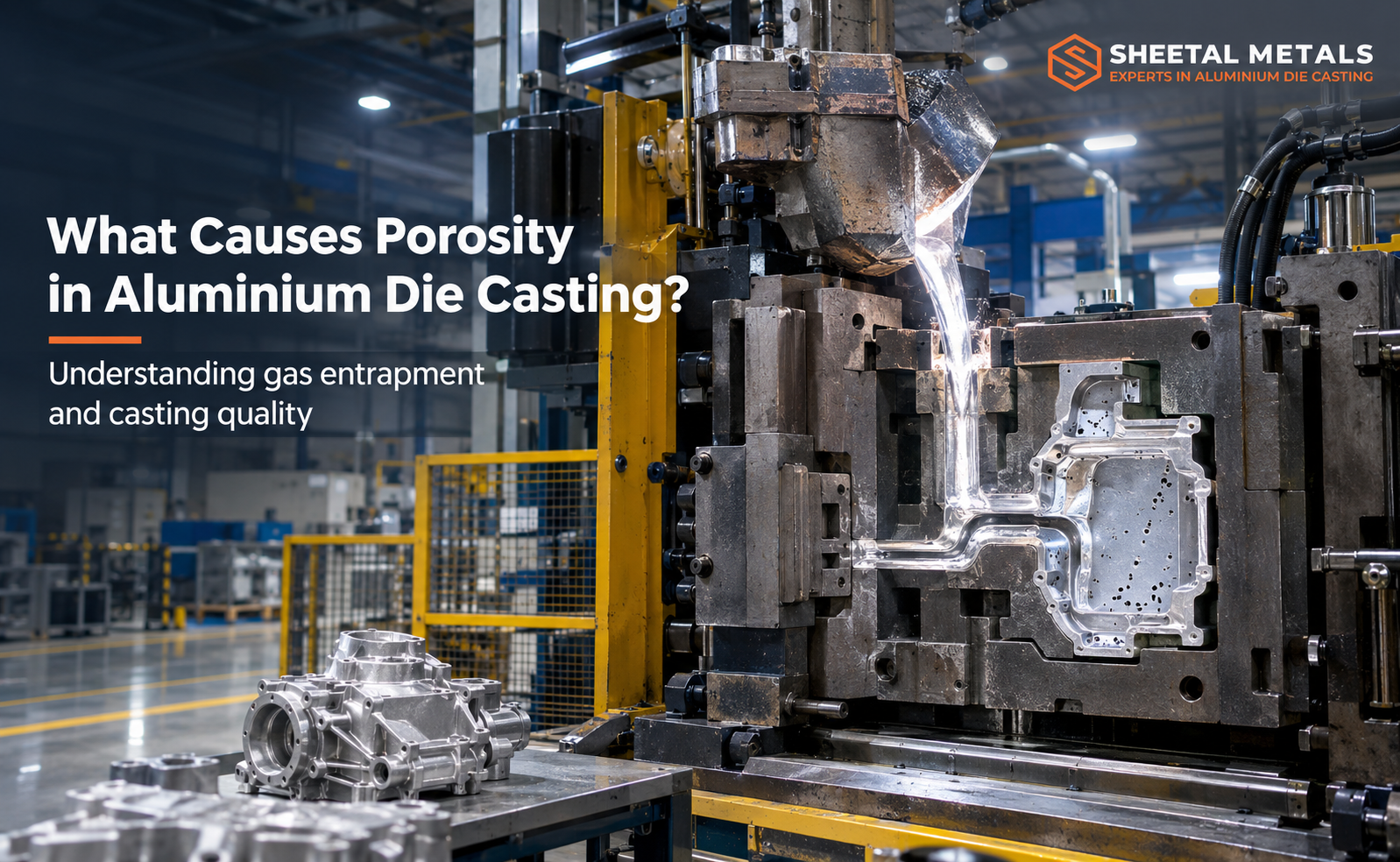
Aluminium die casting is used to produce strong, lightweight, and complex metal components. It is common in automotive, EV, lighting, electronics, solar, and industrial applications.
However, one issue can affect the quality of a die cast component: porosity.
Porosity means small holes or voids inside the metal. These voids may be visible on the surface or remain hidden inside the component.
Porosity does not always mean that a casting is unusable. Its effect depends on the size, location, amount, and application of the component.
Understanding the causes of porosity helps manufacturers improve casting quality and process consistency.
What Is Porosity in Aluminium Die Casting?
Porosity is the presence of small cavities inside an aluminium casting.
These cavities can form during the casting process. They may contain trapped gas or result from metal shrinkage during solidification.
Some pores are very small. Others can be larger and more concentrated in certain areas.
The main types include:
- Gas porosity
- Shrinkage porosity
- Air entrapment
- Hydrogen-related porosity
Each type can have a different cause.
Therefore, identifying the cause is important before selecting a corrective action.
Why Is Porosity a Concern?
Porosity can affect the performance of an aluminium component.
Its impact depends on where the pores are located.
For example, pores near a machined surface may become exposed during CNC machining. Pores near a sealing area may also create problems if the component must remain pressure-tight.
Porosity can potentially affect:
- Strength
- Leak resistance
- Pressure tightness
- Surface appearance
- Machining quality
- Fatigue performance
- Coating results
This is why porosity control is an important part of aluminium die casting.
1. Gas Porosity
Gas porosity is one of the common forms of porosity in aluminium castings.
It occurs when gas becomes trapped inside the molten metal.
During high-pressure die casting, molten aluminium moves into the die at high speed. If air or gas is not removed properly, it can become trapped in the metal.
As the casting solidifies, these trapped gases can form small internal voids.
Common Causes of Gas Porosity
Gas porosity can be linked to:
- Poor die venting
- Excessive turbulence
- Incorrect injection conditions
- Gas trapped in the die cavity
- Moisture or contamination
- Poor melt handling
Confirm the exact cause through process analysis and inspection.
2. Shrinkage Porosity
Shrinkage porosity forms for a different reason.
Aluminium contracts as it changes from a liquid state to a solid state.
If the metal cannot feed areas that shrink during solidification, internal voids may develop.
Shrinkage porosity is often associated with areas where metal remains liquid for longer.
These areas can include:
- Thick sections
- Large bosses
- Junctions between walls
- Heavy cross-sections
Good component design and controlled casting conditions can help reduce this risk.
3. Air Entrapment
Air can become trapped when molten aluminium flows through the die cavity.
This is more likely when the metal flow becomes turbulent.
Complex component shapes can make metal flow more difficult to control.
Features such as:
- Thin walls
- Sharp changes in section
- Deep cavities
- Ribs
- Multiple flow paths
can influence how the metal fills the die.
Proper gating, venting, and injection control are therefore important.
4. Moisture and Contamination
Moisture can create problems during aluminium casting.
Water or moisture coming into contact with molten metal can generate gas. This gas may then become trapped inside the casting.
Contamination can also affect melt quality.
For this reason, proper control of:
- Aluminium charge material
- Melting conditions
- Tools
- Dies
- Lubricants
- Storage areas
is important.
Good housekeeping is a simple but valuable part of porosity prevention.
How Can Porosity Be Reduced?
Porosity cannot be controlled through one single adjustment.
It requires control across several stages of the casting process.
Here are some important areas to consider.
1. Improve Die Venting
Venting allows air and gases to escape from the die cavity.
If the venting system is not suitable, air can remain trapped as molten aluminium enters the cavity.
Effective venting can therefore support better cavity filling and reduce air entrapment.
Vent locations and sizes should be selected according to the component design and metal flow.
2. Control Metal Flow
The way molten aluminium enters the die has a direct effect on casting quality.
Very turbulent flow can increase the chance of air entrapment.
Process engineers can review factors such as:
- Injection speed
- Gate design
- Runner design
- Metal temperature
- Filling pattern
The goal is to achieve controlled and repeatable filling.
3. Maintain Proper Metal Temperature
Molten aluminium needs to remain within a suitable temperature range during casting.
If the temperature is too low, the metal may begin to solidify before the cavity is filled properly.
If it is too high, it may increase other process risks.
Consistent temperature control helps create a more stable casting process.
The correct range depends on the aluminium alloy, component design, and casting process.
4. Use Suitable Component Design
Component design has a major role in porosity control.
Sudden changes in wall thickness can create difficult solidification conditions.
Designers should consider:
- Uniform wall thickness
- Smooth transitions
- Suitable fillets
- Proper rib design
- Avoidance of unnecessary thick sections
Designing with the casting process in mind can reduce potential problem areas before production begins.
5. Control Die Temperature
Die temperature affects how quickly the molten aluminium loses heat.
If different areas of the die have very different temperatures, solidification can become less predictable.
Controlled die temperature can help create more stable filling and solidification conditions.
This is especially important for complex components with different wall sections.
6. Keep the Melt Clean
The quality of the molten aluminium matters.
Oxides, moisture, and other unwanted material can affect casting quality.
Good melt management includes proper handling of raw material and controlled melting practices.
Clean and consistent melt conditions can support more reliable production.
7. Monitor the Casting Process
Porosity prevention is not only about setting the machine once.
Production conditions should be monitored over time.
Important parameters can include:
- Metal temperature
- Die temperature
- Injection conditions
- Cycle time
- Machine settings
- Material condition
Regular monitoring helps identify process changes before they create larger production issues.
How Is Porosity Detected?
Porosity may not always be visible from the outside.
A component can look good on the surface and still contain internal voids.
Different inspection methods can be used depending on the component and customer requirements.
Visual Inspection
Visual inspection can identify visible surface defects.
It is useful for checking the general appearance of a casting.
However, it cannot identify all internal pores.
X-Ray Inspection
X-ray inspection can help identify internal defects.
It can show the location and distribution of internal voids without cutting the component open.
This can be useful for critical aluminium castings.
Sectioning
A sample component can be cut through selected areas for internal examination.
This can help manufacturers understand the location and size of internal defects.
The suitable inspection method depends on the component, specification, and required level of quality control.
Why Process Consistency Matters
A good casting process should produce consistent results.
If machine settings, temperatures, material conditions, or die conditions change frequently, defect levels can also change.
Consistent production control helps manufacturers identify problems more quickly.
It also makes corrective action easier.
For high-volume production, this becomes even more important because a small process issue can affect many components.
How Sheetal Metals Approaches Aluminium Die Casting
Sheetal Metals provides aluminium pressure die casting for components used across automotive, EV, lighting, electronics, solar, pumping, and industrial applications.
The manufacturing process is supported by capabilities such as product design and simulation, die development, casting, machining, shot blasting, powder coating, and inspection.
This allows process requirements to be considered across different production stages.
For components where internal quality is important, casting conditions and inspection requirements should be defined according to the application and customer specifications.
What Should OEMs Consider?
OEMs should discuss porosity requirements before production begins.
Important questions include:
- Is the component pressure-tight?
- Which areas require machining?
- Are there critical sealing surfaces?
- What level of internal porosity is acceptable?
- Is X-ray inspection required?
- What aluminium alloy will be used?
- What are the dimensional and performance requirements?
Clear specifications help manufacturers select suitable production and inspection controls.
A Practical Approach to Porosity Control
Porosity prevention works best when it is treated as a process requirement.
A practical approach includes:
Step 1: Review the component design.
Step 2: Study metal flow and potential air-trap areas.
Step 3: Select suitable gating and venting.
Step 4: Control metal and die temperatures.
Step 5: Maintain stable injection conditions.
Step 6: Monitor production parameters.
Step 7: Inspect samples according to the required quality standard.
Step 8: Investigate defects and correct the process when needed.
This approach helps move porosity control from reactive problem-solving to planned process control.
Conclusion
Porosity is a common technical concern in aluminium die casting.
It can result from trapped gas, air entrapment, shrinkage, moisture, or process conditions.
The solution is not always one machine adjustment.
Effective porosity control can involve die design, venting, metal flow, temperature control, melt quality, component design, process monitoring, and inspection.
When these factors are managed carefully, manufacturers can improve casting consistency and reduce the risk of unwanted internal defects.
For OEMs, the key is to define quality requirements early and work with a manufacturing process designed around the final application.
Sheetal Metals supports aluminium pressure die casting and related manufacturing processes with a focus on controlled production, component quality, and application-specific requirements.
📅 Last updated:
