
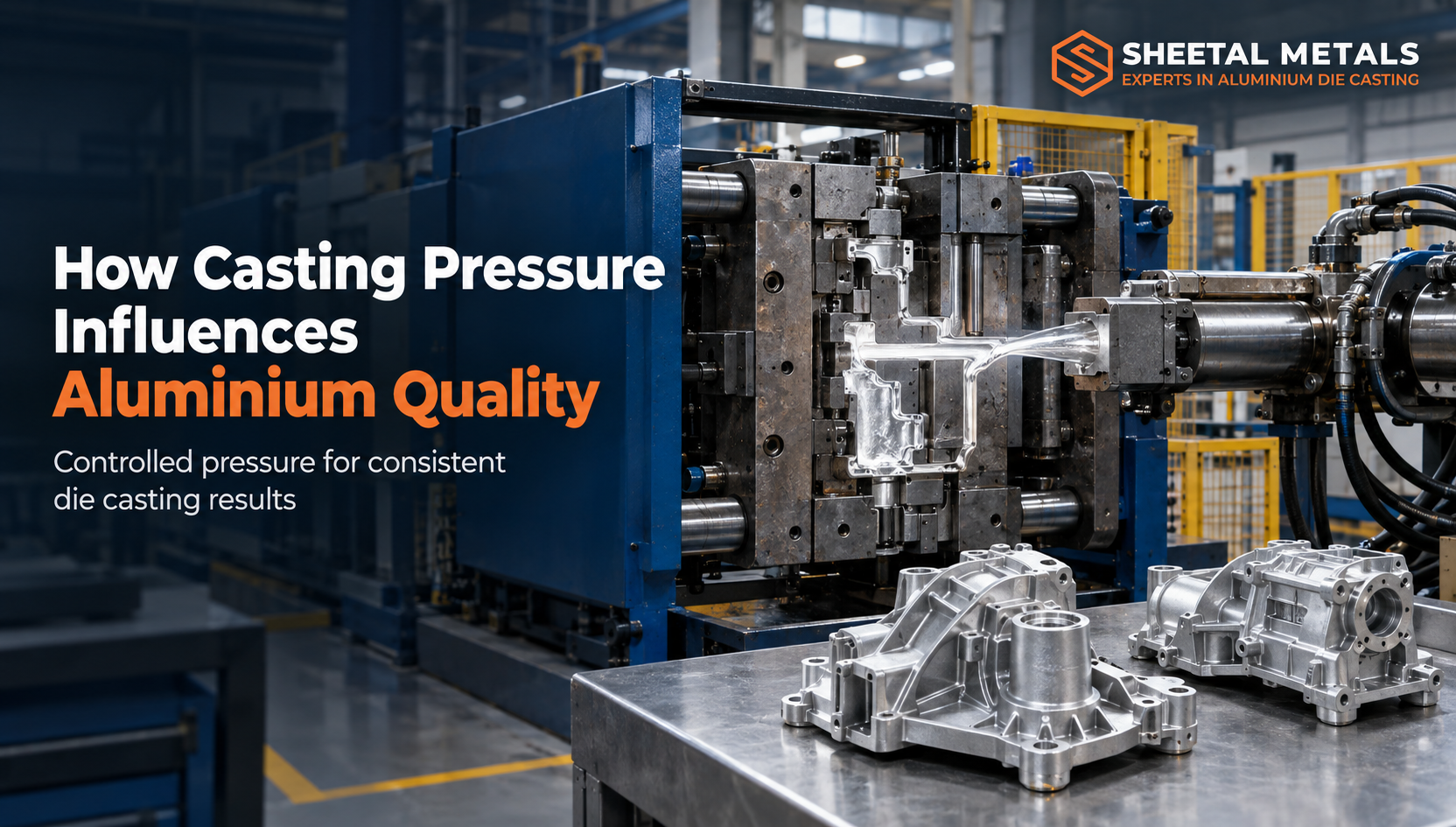
Aluminium pressure die casting is used to make strong, lightweight, and complex components.
The process uses pressure to push molten aluminium into a steel die.
This helps manufacturers create detailed shapes with good repeatability.
But one factor is especially important: casting pressure.
The right pressure helps molten aluminium fill the die correctly. It can also support better surface quality, dimensions, and production consistency.
So, how does casting pressure affect aluminium components?
Let’s take a closer look.
What Is Casting Pressure?
Casting pressure is the force used to push molten aluminium into the die cavity.
The metal needs to fill the cavity quickly.
It must also reach thin walls, ribs, corners, and other small features.
The required pressure depends on several factors:
- Component size
- Component shape
- Wall thickness
- Aluminium alloy
- Die design
- Machine capacity
- Injection conditions
- Required quality
There is no single pressure setting for every component.
Each casting needs the right process settings.
Why Is Casting Pressure Important?
Casting pressure controls how molten aluminium moves inside the die.
When the pressure is well controlled, the metal can fill the cavity more smoothly.
This can help support:
- Better die filling
- Consistent dimensions
- Good surface detail
- Better reproduction of small features
- Lower defect risk
- Stable production
However, more pressure does not always mean better quality.
The pressure must match the component and the complete casting process.
1. Pressure Helps Fill the Die
A die can have many complex features.
It may include:
- Thin walls
- Ribs
- Bosses
- Mounting points
- Narrow sections
- Deep areas
Molten aluminium needs to reach these areas before it starts to solidify.
Suitable pressure helps move the metal through the die quickly.
If the filling conditions are not correct, some areas may not fill properly.
This can lead to defects such as:
- Misruns
- Cold shuts
- Incomplete filling
- Missing details
Proper pressure works together with injection speed and metal temperature.
2. Pressure Affects Surface Quality
The finished casting should reproduce the details of the die surface.
Controlled pressure helps molten aluminium reach the die walls effectively.
This is useful for components with:
- Fine ribs
- Small grooves
- Textured surfaces
- Detailed shapes
- Decorative features
However, pressure is only one part of surface quality.
Die condition, lubrication, metal temperature, and injection speed also matter.
3. Pressure Supports Dimensional Consistency
Many aluminium components must fit with other parts.
Even small dimensional changes can create assembly problems.
Stable casting pressure can help create more repeatable filling conditions.
This can support better consistency between production cycles.
But pressure alone does not control dimensions.
Other factors also matter:
- Die temperature
- Die wear
- Metal temperature
- Alloy behavior
- Machine settings
- Post-casting machining
All these factors should be controlled together.
4. Pressure Can Affect Internal Defects
Internal defects are another important concern.
Poorly controlled metal flow can increase the risk of air entrapment.
This can lead to internal voids in the casting.
The solution is not simply to increase pressure.
Manufacturers should also review:
- Injection speed
- Gate design
- Runner design
- Die venting
- Metal temperature
- Die temperature
A balanced process can help reduce the risk of casting defects.
5. Pressure Helps Create Complex Components
Modern aluminium components often have complex designs.
A single casting may include several ribs, bosses, mounting points, and thin sections.
These features require controlled metal flow.
Suitable pressure helps molten aluminium reach detailed areas before solidification.
This makes pressure die casting suitable for many applications.
These include:
- Automotive components
- EV components
- Lighting products
- Electronic housings
- Solar equipment
- Industrial components
- Pumping equipment
What Happens When Pressure Is Too Low?
If the pressure is too low for the component, the molten aluminium may not fill the die properly.
Possible problems include:
- Incomplete filling
- Cold shuts
- Misruns
- Poor surface detail
- Inconsistent casting quality
Thin and complex components can be more sensitive to these conditions.
However, increasing pressure should not be the first solution.
The complete casting process should be checked first.
What Happens When Pressure Is Too High?
Higher pressure does not automatically produce better results.
Excessive pressure can place additional stress on the die and machine.
It can also change metal flow conditions.
This may create other production challenges.
For this reason, pressure should be selected based on:
- Component design
- Die design
- Aluminium alloy
- Injection conditions
- Machine capability
- Quality requirements
The goal is controlled pressure, not maximum pressure.
Casting Pressure and Die Design
Die design has a major effect on metal flow.
Molten aluminium passes through the runner and gate before entering the main cavity.
The design of these areas affects how the metal moves.
Important factors include:
- Gate position
- Runner design
- Cavity layout
- Vent locations
- Wall thickness
- Overflow locations
A suitable pressure setting cannot fully correct poor die design.
The die and machine settings must work together.
Casting Pressure and Aluminium Temperature
Temperature also affects casting pressure requirements.
Molten aluminium needs to stay fluid while filling the die.
If the metal cools too quickly, filling can become difficult.
If the temperature is too high, it can create other process challenges.
The suitable temperature depends on the:
- Aluminium alloy
- Component design
- Die design
- Casting process
Stable temperature control helps create a more consistent casting process.
How Is Casting Pressure Controlled?
Manufacturers monitor several process conditions during production.
These can include:
- Injection pressure
- Injection speed
- Metal temperature
- Die temperature
- Machine settings
- Filling behavior
- Casting results
The production team can compare these conditions with inspection results.
If a defect appears, the process can then be reviewed.
This is more effective than changing pressure without identifying the actual cause.
Why Process Stability Matters
A good casting process should produce consistent results.
Frequent changes in pressure or temperature can create differences between components.
Stable process conditions can help maintain:
- Consistent dimensions
- Repeatable surface quality
- Better cavity filling
- Lower defect variation
- Reliable production
This becomes especially important during high-volume manufacturing.
Sheetal Metals and Aluminium Die Casting
Sheetal Metals provides aluminium pressure die casting for different industrial applications.
These include:
- Automotive
- EV
- Lighting
- Electronics
- Solar
- Pumping
- Industrial products
The manufacturing process is supported by capabilities such as:
- Product design and simulation
- Die design and development
- Pressure die casting
- Shot blasting
- CNC machining
- VMC machining
- Powder coating
- Inspection
This allows different production requirements to be considered across the manufacturing process.
What Should OEMs Consider?
OEMs should define important casting requirements before production starts.
These may include:
- Component dimensions
- Wall thickness
- Critical features
- Surface requirements
- Internal quality requirements
- Machining requirements
- Production volume
- Inspection requirements
Clear requirements help the manufacturer select suitable process conditions.
They also make quality control easier during production.
Conclusion
Casting pressure is an important part of aluminium pressure die casting.
It affects how molten aluminium fills the die.
It can also influence:
- Surface detail
- Dimensional consistency
- Internal quality
- Complex features
- Production stability
But pressure does not work alone.
Die design, injection speed, metal temperature, die temperature, venting, alloy selection, and process control all affect the final casting.
The goal is not to use the highest pressure.
The goal is to use the right pressure for the component.
With controlled casting conditions and proper process monitoring, manufacturers can achieve more consistent aluminium components.
Sheetal Metals supports aluminium pressure die casting and related manufacturing processes for customers with specific component and production requirements.
📅 Last updated:
