
The electric vehicle (EV) industry is growing faster than ever.
Every year, manufacturers introduce new technologies to improve driving range, safety, charging speed, and vehicle performance. However, one factor continues to influence every innovation—vehicle weight.
A lighter vehicle consumes less energy. It accelerates better, travels farther on a single charge, and puts less stress on critical components.
That is why lightweight aluminium components have become an essential part of modern electric vehicle manufacturing.
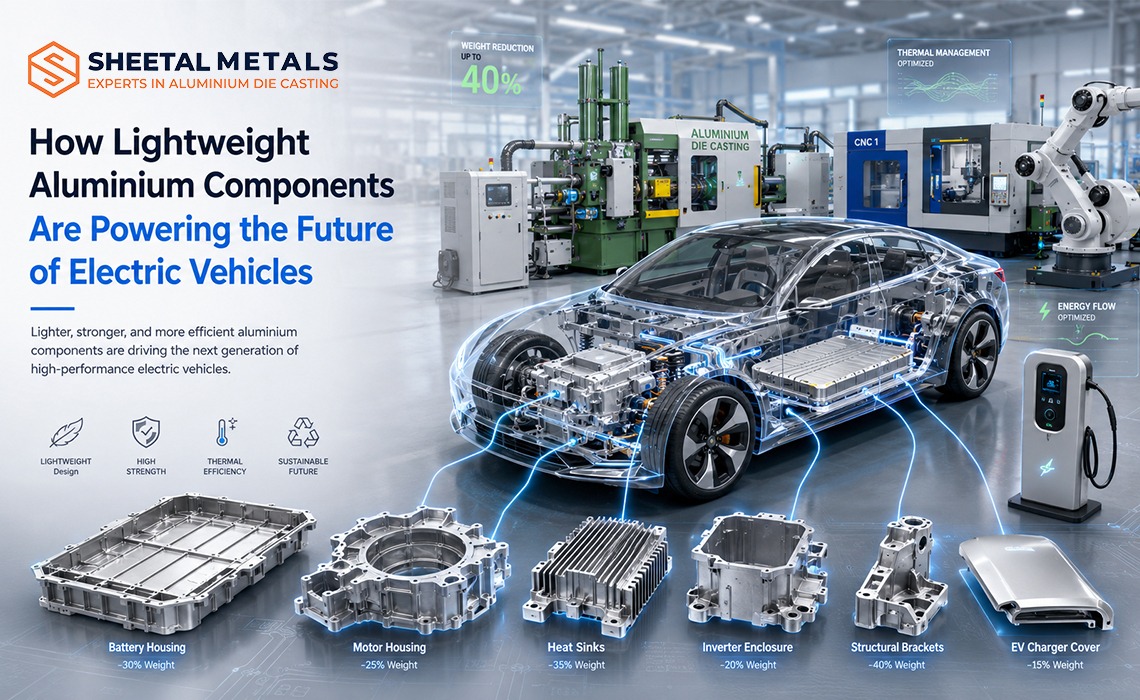
Today, aluminium is used in battery housings, motor casings, inverter enclosures, heat sinks, structural brackets, and many other EV parts. When combined with advanced pressure die casting and precision machining, aluminium enables manufacturers to produce components that are strong, durable, and highly accurate.
Companies such as Sheetal Metals support this transformation by manufacturing precision aluminium components for modern industries.
Why Weight Matters in Electric Vehicles
Every kilogram matters in an electric vehicle.
Unlike conventional vehicles, EVs rely entirely on battery power. If the vehicle is heavier, the battery must work harder to move it.
This increases energy consumption and reduces driving range.
A lighter vehicle offers several important advantages.
It can travel farther on a single charge.
It also improves acceleration, braking, and overall efficiency.
This is why manufacturers are replacing heavier materials with aluminium wherever possible.
Reducing weight without compromising strength has become a major goal in EV design.
Why Aluminium Is the Preferred Material
Aluminium offers an excellent balance of strength, durability, and low weight.
It is much lighter than steel while still providing the mechanical strength required for demanding applications.
This combination makes aluminium ideal for electric vehicle components.
Manufacturers also prefer aluminium because it offers the following:
- Excellent corrosion resistance
- High thermal conductivity
- Good dimensional stability
- Easy recyclability
- Long service life
These properties help improve both vehicle performance and sustainability.
Aluminium Pressure Die Casting Makes Large-Scale Production Possible
Producing millions of EV components requires a manufacturing process that is both fast and accurate.
This is where aluminium pressure die casting plays an important role.
The process injects molten aluminium into a hardened steel die under high pressure.
The metal fills every detail of the die and quickly forms the required shape.
This process offers several advantages.
Manufacturers can produce complex components with excellent dimensional accuracy.
Production cycles remain fast and consistent.
Material waste is also reduced.
As EV demand continues to grow, pressure die casting helps manufacturers increase production without sacrificing quality.
Lightweight Components Improve Battery Range
Battery range is one of the biggest concerns for EV buyers.
Every improvement in efficiency helps manufacturers build more competitive vehicles.
Lightweight aluminium components directly support this goal.
When the total vehicle weight decreases, the battery requires less energy to move the vehicle.
This allows drivers to travel longer distances without increasing battery size.
The result is better efficiency and improved customer satisfaction.
For manufacturers, this creates a significant competitive advantage.
Better Heat Management Improves Performance
Electric vehicles generate heat during charging and operation.
Batteries, motors, and power electronics all require effective cooling.
Aluminium naturally transfers heat more efficiently than many other materials.
Because of this, manufacturers use aluminium to produce:
- Heat sinks
- Motor housings
- Battery enclosures
- Power electronics housings
- Charger components
Efficient heat dissipation helps improve system performance and protects sensitive electronic components.
It also contributes to longer battery life.
Complex Designs Become Easier to Manufacture
Modern EV components are becoming more advanced every year.
Many parts include thin walls, detailed features, and intricate internal structures.
Traditional manufacturing methods may struggle to produce these designs efficiently.
Aluminium pressure die casting solves this challenge.
The process allows manufacturers to create complex geometries while maintaining high production speed.
This gives engineers greater design flexibility and reduces the need for multiple assembled parts.
Simpler assemblies often lead to improved reliability and lower manufacturing costs.
Precision Machining Completes the Process
After die casting, many components require additional machining.
CNC machining improves critical dimensions, threaded holes, sealing surfaces, and mounting areas.
This additional step ensures every component meets strict engineering specifications.
Precision machining provides:
- Better dimensional accuracy
- Improved surface finish
- Reliable assembly
- Consistent quality
- Higher product performance
The combination of pressure die casting and CNC machining delivers components that meet the demanding standards of the EV industry.
Sustainability Supports the Future of Mobility
Sustainability is now a priority across the automotive industry.
Manufacturers want materials that reduce environmental impact while maintaining excellent performance.
Aluminium supports both goals.
It is highly recyclable and can be reused multiple times without losing its essential properties.
Recycling aluminium also requires significantly less energy than producing new material.
This helps reduce carbon emissions and supports more sustainable manufacturing practices.
As electric mobility continues to grow, recyclable materials will play an even greater role.
Where Lightweight Aluminium Components Are Used
Modern electric vehicles contain aluminium components in many important systems.
Common applications include:
- Battery housings
- Motor housings
- Heat sinks
- Inverter enclosures
- EV charger covers
- Structural brackets
- Transmission housings
- Electronic control unit housings
Each of these components benefits from aluminium’s combination of strength, low weight, and excellent thermal performance.
How Sheetal Metals Supports EV Manufacturing
Manufacturing high-quality EV components requires advanced technology and consistent quality control.
Sheetal Metals supports modern manufacturers through aluminium pressure die casting, CNC machining, and integrated finishing capabilities.
By combining these manufacturing processes under one roof, the company delivers precision aluminium components that meet the evolving requirements of the electric vehicle industry.
Its focus on quality, accuracy, and production efficiency helps manufacturers build reliable products for the future of mobility.
Conclusion
The future of electric vehicles depends on smarter materials and more efficient manufacturing.
Lightweight aluminium components have become one of the biggest drivers of this transformation.
They reduce vehicle weight, improve battery range, support better thermal management, and enable complex component designs.
By combining aluminium pressure die casting with precision CNC machining, manufacturers can produce reliable, high-performance components at scale.
As the EV industry continues to expand, lightweight aluminium will remain a key material for building safer, more efficient, and more sustainable electric vehicles.
Manufacturers that invest in advanced aluminium manufacturing today are helping shape the next generation of electric mobility.
📅 Last updated:
