Technology is advancing at an incredible pace.
Electric vehicles (EVs), smart electronics, renewable energy systems, industrial automation, and high-performance computing all rely on powerful electronic components. While these innovations improve performance, they also generate significant heat during operation.
Excessive heat can reduce efficiency, shorten product life, and even cause system failure.
That is why thermal management has become one of the most important aspects of modern product design.
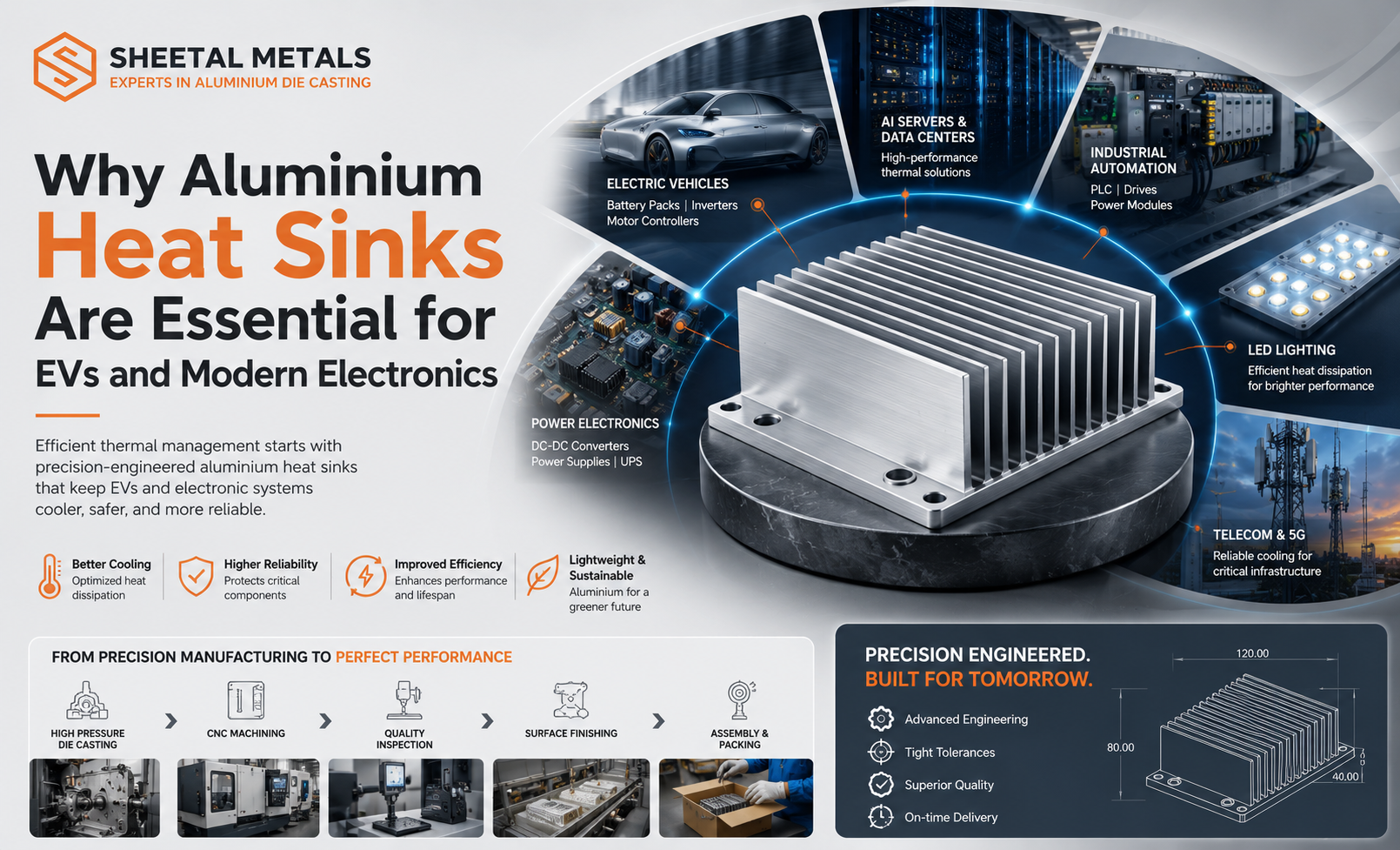
Among all cooling solutions, aluminium heat sinks remain the preferred choice. They efficiently dissipate heat, improve system reliability, and support the long-term performance of electronic devices and EV components.
With advanced aluminium pressure die casting and precision machining, manufacturers like Sheetal Metals produce high-quality aluminium heat sinks that meet the demanding requirements of today’s industries.
What Is an Aluminium Heat Sink?
A heat sink is a component designed to absorb and transfer heat away from electronic devices.
As electrical current flows through components, heat builds up naturally. Without proper cooling, temperatures continue to rise, reducing efficiency and damaging sensitive parts.
An aluminium heat sink absorbs this heat and releases it into the surrounding air through specially designed cooling fins.
This simple but highly effective process keeps devices operating within safe temperature limits.
Because of its excellent thermal conductivity and lightweight nature, aluminium has become the industry standard for heat sink manufacturing.
Why Thermal Management Matters
Every electronic system generates heat.
The more powerful the system becomes, the greater the amount of heat it produces.
If this heat is not controlled, several problems can occur.
These include:
- Reduced efficiency
- Lower operating life
- Component failure
- Performance loss
- Increased maintenance costs
Proper thermal management prevents these issues.
It keeps temperatures stable and allows electronic systems to operate safely for longer periods.
This is especially important for electric vehicles, where batteries, motors, and power electronics generate continuous heat.
Why Aluminium Is the Preferred Material
Manufacturers choose aluminium because it offers an ideal combination of performance and practicality.
It is lightweight, durable, corrosion-resistant, and an excellent conductor of heat.
These properties make it suitable for both automotive and industrial applications.
Key advantages include the following:
- Excellent heat dissipation
- Lightweight construction
- High corrosion resistance
- Long service life
- Easy recyclability
- Cost-effective manufacturing
These benefits explain why aluminium heat sinks are widely used across multiple industries.
How Aluminium Heat Sinks Improve EV Performance
Electric vehicles depend on efficient thermal management.
Without proper cooling, critical systems can overheat during charging, acceleration, or continuous operation.
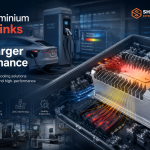
Aluminium heat sinks help maintain safe operating temperatures for several important EV components.
These include:
- Battery management systems
- Power control units
- Motor controllers
- Inverters
- DC-DC converters
- On-board chargers
Efficient cooling improves battery performance and helps extend driving range.
It also protects sensitive electronic systems and supports long-term vehicle reliability.
As EV technology continues to evolve, thermal management becomes even more critical.
Aluminium Heat Sinks Support Modern Electronics
Heat management is equally important in electronic products.
Consumers expect faster devices, higher processing power, and compact designs.
These improvements increase heat generation.
Aluminium heat sinks help maintain safe temperatures in products such as:
- LED lighting systems
- Industrial controllers
- Telecom equipment
- Medical devices
- Power supplies
- Consumer electronics
- AI computing hardware
- Industrial automation systems
Reliable cooling allows these devices to perform consistently without overheating.
Pressure Die Casting Produces Efficient Heat Sinks
Modern aluminium heat sinks require precise shapes and complex fin structures.
Aluminium pressure die casting makes this possible.
During the process, molten aluminium is injected into precision steel dies under high pressure.
This produces heat sinks with:
- Excellent dimensional accuracy
- Thin cooling fins
- Smooth surface finish
- Consistent quality
- High production efficiency
Pressure die casting also supports large-volume manufacturing while maintaining excellent repeatability.
This makes it ideal for industries requiring thousands of identical components.
CNC Machining Enhances Precision
Many aluminium heat sinks require additional machining after die casting.
CNC machining improves critical dimensions and functional areas.
It provides:
- Accurate mounting holes
- Flat contact surfaces
- Better dimensional tolerances
- Improved assembly accuracy
- Consistent product quality
The combination of pressure die casting and CNC machining creates heat sinks that meet demanding engineering standards.
Sustainability Makes Aluminium Even More Valuable
Sustainability has become a major priority across global manufacturing.
Aluminium supports environmentally responsible production because it is highly recyclable.
Unlike many materials, aluminium can be recycled repeatedly without losing its properties.
Recycling also requires significantly less energy than producing primary aluminium.
This helps manufacturers reduce waste, lower carbon emissions, and support sustainable manufacturing goals.
As industries move toward greener production, aluminium continues to play an important role.
Industries That Depend on Aluminium Heat Sinks
Today, aluminium heat sinks are used across many sectors.
Some of the most common applications include:
- Electric vehicles
- Automotive electronics
- Renewable energy systems
- LED lighting
- Consumer electronics
- Industrial automation
- Telecommunications
- Medical equipment
- Robotics
- Data centers
Each industry depends on effective thermal management to improve product performance and reliability.
How Sheetal Metals Supports Advanced Manufacturing
Producing reliable aluminium heat sinks requires advanced manufacturing capabilities and strict quality control.
Sheetal Metals combines aluminium pressure die casting, CNC machining, and integrated finishing processes to manufacture precision aluminium components for modern industries.
Its manufacturing expertise supports applications across electric vehicles, electronics, industrial equipment, and other high-performance sectors.
By focusing on dimensional accuracy, production consistency, and product quality, Sheetal Metals helps customers meet the growing demand for reliable thermal management solutions.
Conclusion
As electric vehicles and advanced electronics become more powerful, effective thermal management is no longer optional.
It is essential.
Aluminium heat sinks provide an efficient, lightweight, and reliable solution for controlling heat in demanding applications.
Their excellent thermal conductivity, corrosion resistance, durability, and recyclability make them the preferred choice for manufacturers worldwide.
When combined with aluminium pressure die casting and precision CNC machining, heat sinks can be produced with outstanding accuracy and consistent quality.
As industries continue to innovate, aluminium heat sinks will remain a key component in improving efficiency, protecting electronic systems, and supporting the future of sustainable technology.
Whether used in electric vehicles, industrial automation, renewable energy, or consumer electronics, aluminium heat sinks play a critical role in keeping modern technology cool, reliable, and efficient.
📅 Last updated: