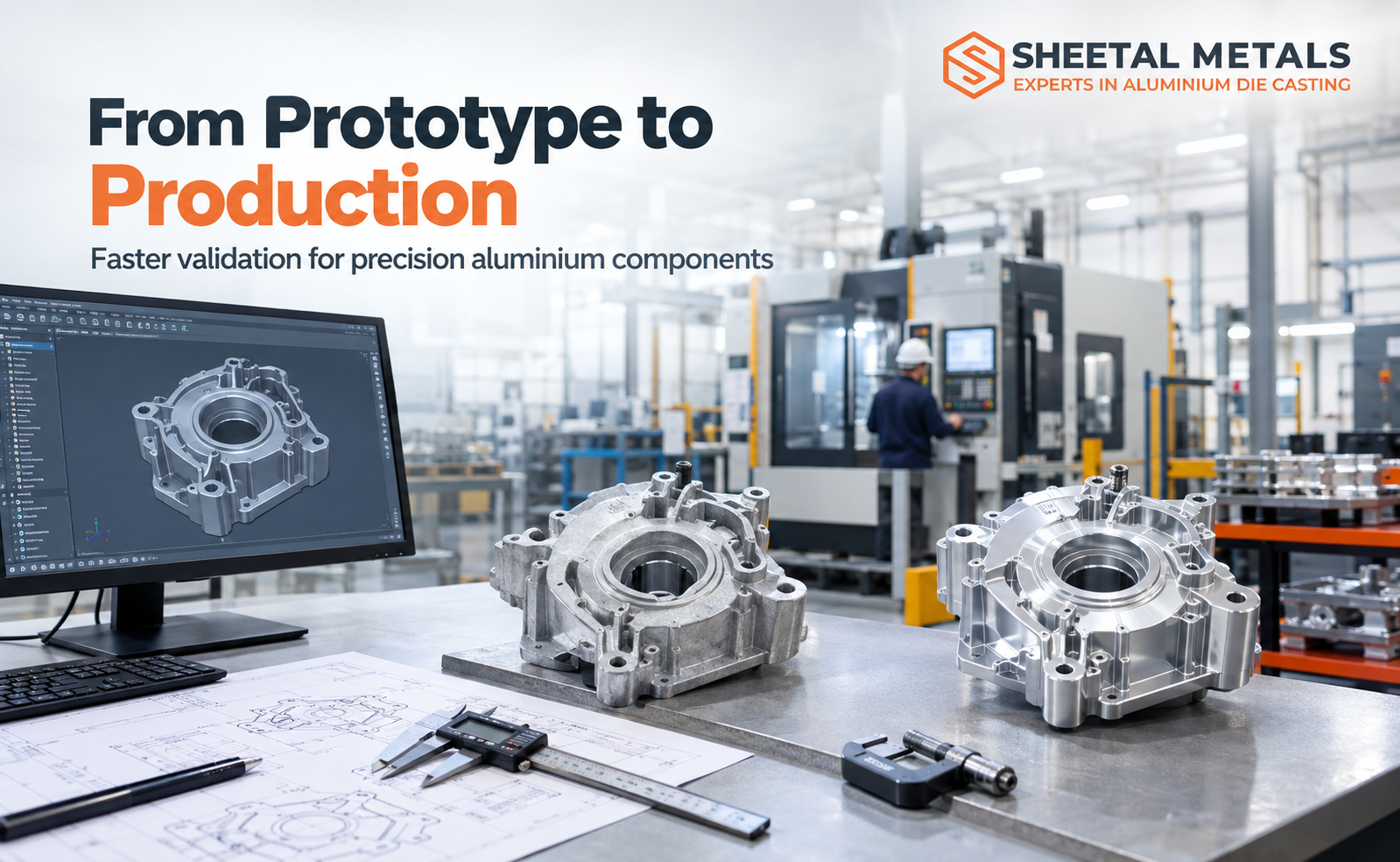
Developing a new aluminium component takes careful planning.
A good design must do more than look right on a computer screen. It must fit correctly, perform its function, and work well with the final manufacturing process.
This is where rapid prototyping becomes valuable.
Rapid prototyping helps engineers create and review an early version of a component before full-scale production begins. It gives the development team a physical part to inspect, measure, test, and improve.
For aluminium component development, this can help reduce design risks and make the move toward production smoother.
What Is Rapid Prototyping?
Rapid prototyping is the process of creating a physical version of a product or component before final production.
The prototype represents important features of the planned part. It allows engineers to check the design in a practical way.
A prototype can help review:
- Shape
- Size
- Dimensions
- Fit
- Function
- Assembly
- Mounting points
- Design features
The exact prototyping method depends on the component and project requirements.
The main goal is simple: test and improve the design before committing to full production.
Why Is Rapid Prototyping Important?
A digital design provides useful information.
However, a physical prototype can reveal issues that may not be obvious on a screen.
For example, a prototype may show that:
- A mounting point needs adjustment.
- Two parts do not fit correctly.
- A wall is too thin.
- A hole is in the wrong position.
- A component is difficult to assemble.
- A feature needs to be changed.
Finding these issues early can make development easier.
It can also reduce the need for major changes after production tooling has started.
1. Helps Validate the Design
A prototype gives engineers a physical component to evaluate.
They can hold it, measure it, and compare it with the intended design.
This is useful for checking important features such as:
- Mounting holes
- Bosses
- Ribs
- Wall sections
- Interfaces
- Overall dimensions
The team can identify areas that need improvement before moving to the next stage.
This makes design validation more practical.
2. Finds Problems Earlier
Design changes are usually easier to manage early in development.
Once production tooling is completed, a major design change can require additional work.
Rapid prototyping creates a checkpoint before that stage.
For example, an engineer may find that a component does not fit correctly with another part.
The design can then be updated, and a new prototype reviewed.
This helps prevent small design problems from becoming production problems.
3. Supports Better Product Development
Product development usually follows several stages.
A typical process can look like this:
Concept → Design → Prototype → Testing → Tool Development → Casting → Machining → Validation
Rapid prototyping supports the early stages of this process.
It allows engineers to review the physical design before moving into production tooling.
This can make the overall development process more organized.
4. Helps Check Fit and Assembly
Aluminium components often form part of a larger product.
They may need to connect with:
- Covers
- Brackets
- Fasteners
- Shafts
- Electronic components
- Housings
- Other mechanical parts
A prototype can help engineers check how these parts fit together.
This is especially useful when a component has several mounting or connection points.
A small change in one area can affect the complete assembly.
Physical testing can reveal these issues early.
5. Supports Manufacturing Decisions
A component may look perfect in a digital model but still be difficult to manufacture.
This is why manufacturing requirements should be considered during development.
For aluminium die casting, engineers may need to review:
- Wall thickness
- Draft angles
- Ribs
- Bosses
- Parting lines
- Machining areas
- Ejection requirements
- Metal flow
Rapid prototyping provides an opportunity to review these features before final tooling.
This can help create a design that is better suited to the production process.
6. Reduces Development Risk
Every new product development project involves some level of uncertainty.
The design may change several times before it is ready for production.
A physical prototype provides a practical way to test these changes.
It can help engineers review:
- Product fit
- Component dimensions
- Assembly
- Function
- Design features
- Manufacturing feasibility
Early testing can reduce uncertainty before larger production investments are made.
7. Makes Customer Feedback Easier
Prototypes can also help customers review a new component.
Instead of reviewing only drawings or digital models, customers can examine a physical part.
They can provide feedback on:
- Design
- Fit
- Function
- Assembly
- Dimensions
- Appearance
The development team can then make suitable changes before production begins.
This can create better communication between the customer and manufacturer.
Rapid Prototyping and Aluminium Die Casting
Rapid prototyping does not replace aluminium die casting.
Instead, it supports the development process before production casting begins.
Once the design is reviewed and validated, the project can move toward die development and production.
A typical process may include:
- Product concept
- 2D or 3D design
- Prototype development
- Design review
- Testing
- Die development
- Aluminium pressure die casting
- Machining
- Surface finishing
- Final inspection
The exact process depends on the component and customer requirements.
The Role of Benchmarking
Benchmarking can support the development of new aluminium components.
It involves studying an existing component or product to understand its important features.
Engineers may review:
- Dimensions
- Weight
- Function
- Material
- Assembly
- Manufacturing method
This information can help identify opportunities for a new or improved design.
Benchmarking can be especially useful when developing a replacement or upgraded component.
The Role of Reverse Engineering
Reverse engineering can help when original design data is not available.
An existing component can be measured and studied to understand its shape and important features.
The information can then support a new digital model.
The process may include:
- Component measurement
- Geometry analysis
- 2D or 3D modelling
- Design improvement
- Prototype development
- Testing
- Production planning
This can help manufacturers develop a new component from an existing physical reference.
From Prototype to Production
A successful prototype is only one part of product development.
The next step is turning the validated design into a production-ready component.
The manufacturing team may review:
- Tooling requirements
- Aluminium alloy
- Casting method
- Machining requirements
- Surface finish
- Inspection requirements
- Production volume
- Packaging requirements
A clear transition from prototype to production can help reduce unnecessary delays.
Sheetal Metals and Component Development
Sheetal Metals supports aluminium component development through capabilities such as product design, rapid prototyping, die development, aluminium pressure die casting, machining, testing, and validation.
The company also provides capabilities related to benchmarking and reverse engineering.
This allows development requirements to be considered before the component enters full-scale production.
For OEM projects, this approach can help connect early design decisions with practical manufacturing requirements.
What OEMs Should Consider
Before starting a new aluminium component project, OEMs should define the key requirements.
These may include:
- Component function
- Required dimensions
- Material requirements
- Production volume
- Assembly requirements
- Machining requirements
- Surface finish
- Testing requirements
- Quality requirements
Clear requirements help the development team create a more suitable prototype.
They also provide a better foundation for production planning.
Why Early Validation Matters
The main value of rapid prototyping is early validation.
A design issue found during prototyping can often be addressed before production tooling is finalized.
This can help reduce rework and improve communication between engineering and manufacturing teams.
It also gives customers greater confidence in the design before full-scale production begins.
For complex aluminium components, this early review can be an important part of the development process.
Conclusion
Rapid prototyping can make aluminium component development more structured and efficient.
It provides a physical way to review a design before full-scale production.
It can help identify issues related to:
- Fit
- Dimensions
- Assembly
- Function
- Design
- Manufacturing feasibility
Rapid prototyping can also work alongside benchmarking and reverse engineering during product development.
The key benefit is simple: find and solve design issues early.
Sheetal Metals combines product development capabilities with aluminium pressure die casting and related manufacturing processes. This helps connect prototype development with tooling, casting, machining, testing, and validation.
For OEMs developing new aluminium components, a well-planned prototype can provide a practical bridge between an initial concept and reliable production.
📅 Last updated: