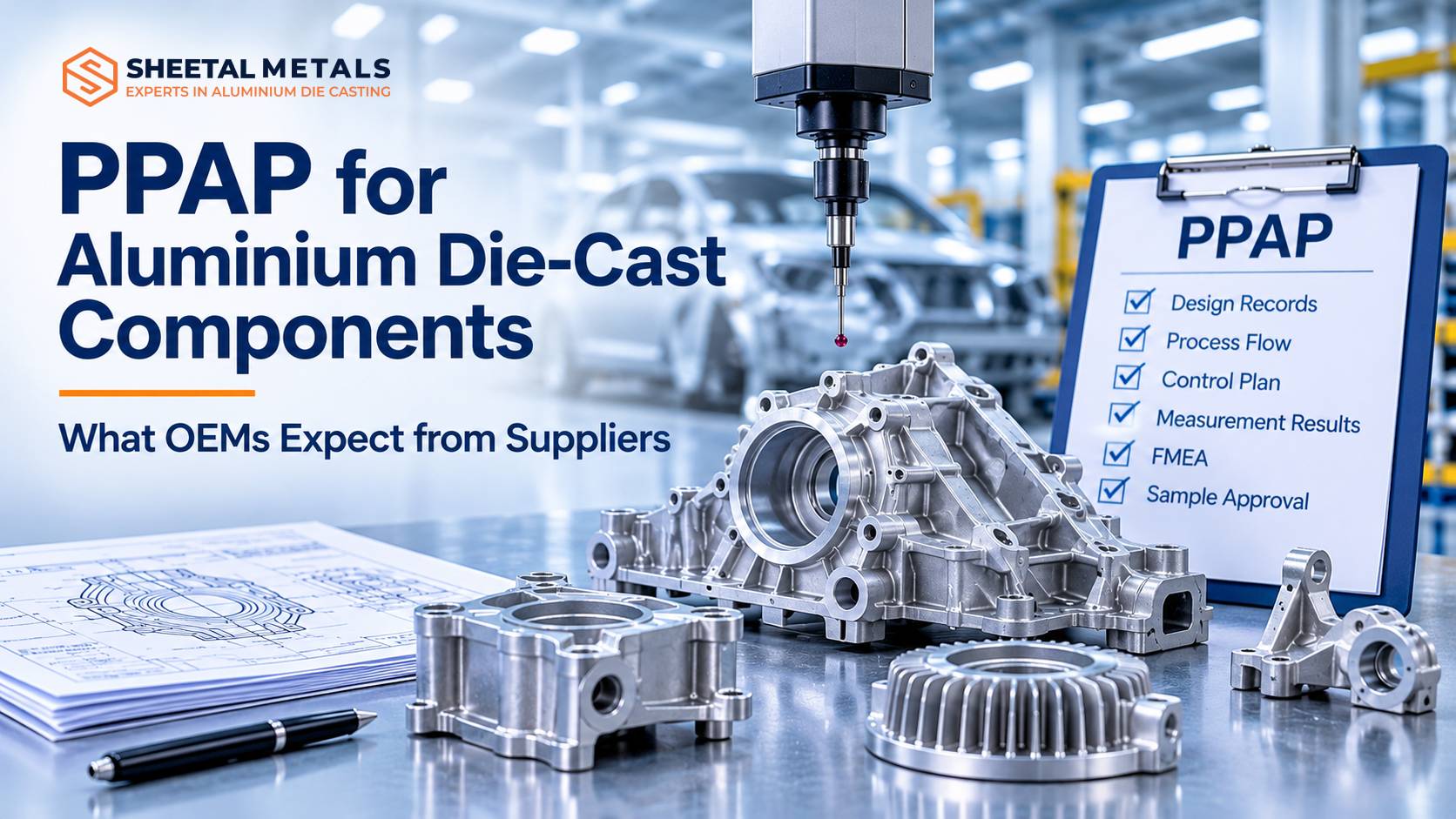
What OEMs Expect from Suppliers
The automotive industry demands reliable components and consistent quality. Every part must meet approved specifications before mass production.
Even a small variation can affect product performance. It can also create assembly problems and production delays.
This is why automotive manufacturers follow strict supplier approval processes. One important process is the Production Part Approval Process (PPAP).
PPAP helps Original Equipment Manufacturers (OEMs) check a supplier’s products and production processes. It provides evidence that the supplier can meet the required specifications.
For aluminium die-cast components, PPAP plays an important role. It connects product design, manufacturing, inspection, and quality control.
Let’s understand what OEMs expect from suppliers during PPAP approval.
1. What Is PPAP in Automotive Manufacturing?
PPAP stands for Production Part Approval Process. It is a standard method used in the automotive supply chain.
The process helps suppliers prove that their products meet customer requirements. It also checks whether their production processes can deliver consistent results.
For aluminium die-cast components, PPAP may cover:
- Component dimensions and specifications
- Material composition and properties
- Manufacturing process details
- Inspection and testing reports
- Production quality controls
- Sample component approval
The main goal is simple. OEMs want proof that suppliers can meet their requirements during regular production.
2. Why Do OEMs Require PPAP Approval?
Automotive components must perform reliably under specific conditions. Therefore, OEMs cannot depend only on initial samples.
They need clear evidence that every approved component meets the required standards.
PPAP helps OEMs in several ways:
Product Verification: It confirms that components meet approved drawing specifications.
Process Verification: It checks whether the manufacturing process can produce acceptable parts.
Risk Reduction: It helps identify possible problems before mass production.
Supplier Evaluation: It gives OEMs a clear view of a supplier’s manufacturing controls.
Furthermore, PPAP improves communication between suppliers and OEM engineering teams. Both parties can review the same technical information before production begins.
3. Important Documents Required for PPAP
PPAP includes several documents and records. The required documents depend on the customer’s submission level.
Some important elements include:
Design Records
Design records contain approved engineering drawings and specifications. They define the component’s dimensions, material, and technical requirements.
Suppliers must always follow the latest approved drawing. Unapproved changes can create serious production issues.
Engineering Change Documents
These documents record approved changes to product design or specifications.
Suppliers must understand how each change affects manufacturing and inspection.
Process Flow Diagram
A process flow diagram shows every major manufacturing step. It explains how raw material becomes a finished component.
A typical aluminium die casting process may include:
- Raw material preparation
- Aluminium melting and casting
- Component trimming
- Shot blasting
- CNC or VMC machining
- Surface finishing
- Final inspection
- Packaging and dispatch
The actual process depends on the component and customer requirements.
Control Plan
A control plan explains how manufacturers monitor production quality.
It identifies important process checks, inspection methods, and control measures.
Measurement Results
Measurement reports compare actual component dimensions with approved drawings.
These reports help identify dimensional variations. They also provide evidence of component accuracy.
4. How Dimensional Inspection Supports PPAP
Dimensional inspection is an important part of component approval.
Automotive drawings often contain critical dimensions. These may include hole positions, mounting points, thickness, and flatness.
Suppliers must check these features using suitable measuring equipment.
Common inspection tools include:
- Vernier calipers
- Micrometers
- Height gauges
- Bore gauges
- Coordinate Measuring Machines (CMM)
The right equipment depends on the component and its measurement requirements.
For complex aluminium components, CMM inspection helps verify multiple dimensions. It also checks important geometric relationships.
Accurate reports help OEMs review component quality. They also help manufacturers identify areas that need improvement.
5. Why Material Verification and Testing Matter
Material selection affects component strength, weight, and performance.
Therefore, suppliers must follow the material specifications provided by OEMs. These specifications may include chemical composition and mechanical properties.
Material verification confirms that the selected alloy meets the required standards.
Depending on the application, customers may also request:
- Chemical composition testing
- Mechanical property testing
- Hardness testing
- Surface finish inspection
- Leak testing
- Functional testing
Not every component requires all these tests. The actual requirements depend on its design and application.
Suppliers should confirm testing requirements before production begins.
6. How Process FMEA Helps Reduce Manufacturing Risks
Failure Mode and Effects Analysis (FMEA) helps manufacturers identify possible production risks.
It examines how a process can fail. It also studies how that failure may affect the finished component.
For aluminium die casting, possible risks include:
- Incomplete metal filling
- Dimensional variations
- Porosity
- Machining errors
- Surface defects
- Incorrect specifications
Process FMEA helps teams plan suitable preventive controls.
For example, a critical mounting hole may need additional inspection. A machined surface may also require dimensional checks after machining.
This approach helps reduce production risks. It also supports more consistent manufacturing.
7. Maintaining Quality After PPAP Approval
PPAP approval does not end quality control.
Suppliers must continue following approved specifications during regular production. Any uncontrolled process change can affect component quality.
OEMs expect suppliers to maintain production discipline.
Important activities include:
- Monitoring casting parameters
- Maintaining dies and equipment
- Following approved machining methods
- Conducting regular inspections
- Recording quality results
- Managing non-conforming components
Suppliers must also follow customer procedures before making changes to approved processes.
Consistent production control helps maintain quality. It also reduces unexpected problems.
8. How Sheetal Metals Supports Aluminium Component Manufacturing
Sheetal Metals provides aluminium pressure die casting and supporting manufacturing services.
Its capabilities include:
- Product design and simulation
- Die design and development
- Aluminium pressure die casting
- CNC and VMC machining
- Shot blasting
- Powder coating
These services support aluminium component manufacturing for automotive, EV, lighting, electronics, solar, and industrial applications.
Every OEM project has specific technical requirements. These may include approved drawings, material specifications, critical dimensions, and finishing standards.
Sheetal Metals supports customers through its casting, machining, and finishing capabilities. OEMs can evaluate these services against their project requirements.
9. What Should OEMs Discuss Before PPAP?
Clear communication helps make the approval process easier.
OEMs and suppliers should discuss important requirements before production starts.
These include:
- Approved engineering drawings
- Material and alloy specifications
- Critical component dimensions
- Expected production volumes
- Inspection methods
- Testing requirements
- PPAP submission level
- Sample approval timelines
These discussions help suppliers understand customer expectations. They also reduce confusion during sample approval.
Conclusion
PPAP is an important part of automotive supplier quality management. It helps OEMs check components and manufacturing processes before production approval.
For aluminium die-cast components, PPAP involves more than submitting samples. It requires proper drawings, process documents, inspection reports, and quality controls.
A capable manufacturing partner must understand these requirements. It must also maintain consistent production standards.
Sheetal Metals offers aluminium pressure die casting, machining, and finishing capabilities for industrial applications. OEMs can evaluate these services against their technical and manufacturing requirements when selecting a supplier.
📅 Last updated: