
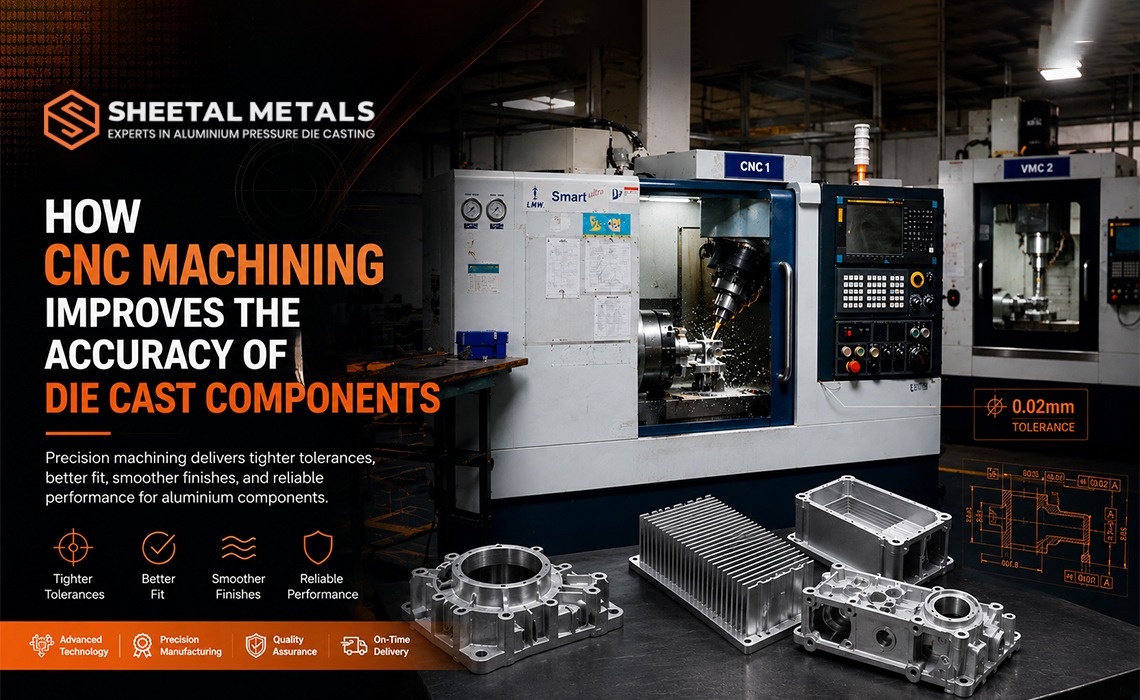
In modern manufacturing, accuracy is everything.
A component that is even slightly out of specification can create problems during assembly. It can reduce product performance, increase production costs, and lead to customer complaints.
That is why manufacturers focus heavily on precision.
While aluminium pressure die casting is an excellent process for producing complex components quickly, some applications require even greater accuracy. This is where CNC machining becomes important.
CNC machining helps refine die-cast components and brings them closer to exact design specifications. The result is a product that fits better, performs better, and lasts longer.
Manufacturers such as Sheetal Metals combine pressure die casting and CNC machining to deliver precision-engineered aluminium components for modern industries.
What Is CNC Machining?
CNC stands for Computer Numerical Control.
It is a manufacturing process that uses computer-controlled machines to shape and finish components with high precision.
The machine follows programmed instructions and removes material from specific areas of a component.
Because the process is automated, every part is produced with the same level of accuracy.
This makes CNC machining one of the most reliable manufacturing methods available today.
Why Die Cast Components Need CNC Machining
Pressure die casting produces high-quality aluminium components.
However, some parts require tighter tolerances than die casting alone can achieve.
For example, a component may need the following:
- Precise mounting holes
- Accurate threaded sections
- Flat sealing surfaces
- Exact dimensions for assembly
In such cases, CNC machining is used after die casting.
The machining process improves critical areas and ensures the final component meets engineering requirements.
This combination delivers both efficiency and precision.
1. CNC Machining Delivers Higher Accuracy
Accuracy is one of the biggest reasons manufacturers use CNC machining.
Many industrial components must fit perfectly with other parts.
Even a small dimensional variation can cause assembly issues.
CNC machining removes material with extreme precision. This allows manufacturers to achieve very tight tolerances.
The benefits include:
- Better dimensional control
- Improved product quality
- More reliable performance
- Greater manufacturing consistency
For industries such as EV and automotive manufacturing, this level of precision is essential.
2. Improves Hole Positioning and Alignment
Many die-cast components contain holes for mounting, fastening, or assembly.
These holes must be positioned correctly.
If the location is slightly off, the component may not fit properly.
CNC machining helps create holes with exceptional accuracy.
This improves:
- Alignment
- Assembly speed
- Product performance
- Installation reliability
Accurate hole positioning is especially important for components used in vehicles and industrial equipment.
3. Creates Smooth and Precise Surfaces
Some surfaces require a higher level of precision than die casting alone can provide.
Examples include:
- Sealing surfaces
- Contact areas
- Mounting faces
- Functional interfaces
CNC machining creates smooth and accurate surfaces that improve product performance.
Better surface quality can also reduce wear and improve long-term reliability.
This is one reason why machining is widely used in high-performance applications.
4. Ensures Consistent Quality
Consistency is critical in manufacturing.
Customers expect every component to meet the same quality standards.
CNC machining helps maintain this consistency.
The machines operate according to programmed instructions.
This means every production cycle follows the same process.
As a result, manufacturers achieve the following:
- Uniform dimensions
- Repeatable quality
- Reduced variation
- Better reliability
Consistent quality helps reduce production problems and improves customer satisfaction.
5. Improves Component Fit
A component should fit correctly the first time.
Poor fit can increase assembly time and create performance issues.
CNC machining improves fit by refining critical dimensions.
This helps ensure that components work exactly as intended.
A better fit provides several advantages:
- Faster assembly
- Lower production costs
- Improved reliability
- Better overall performance
These benefits become even more important in large-scale manufacturing environments.
6. Reduces Defects and Rework
Manufacturing defects can be expensive.
Rejected parts increase costs and slow production.
CNC machining helps reduce these problems.
The process corrects critical dimensions and improves component quality.
This results in:
- Fewer defects
- Less rework
- Lower waste
- Higher productivity
Reducing defects is one of the most effective ways to improve manufacturing efficiency.
7. Enhances Product Performance
The final goal of every manufacturing process is to create a better product.
Accurate components perform more reliably.
They fit correctly, function properly, and last longer.
CNC machining improves:
- Mechanical performance
- Structural strength
- Thermal efficiency
- Product lifespan
For industries that demand precision, these improvements can make a significant difference.
Industries That Depend on CNC Machining
Many industries use CNC machining to achieve high-quality results.
Electric Vehicle Industry
Electric vehicles contain many precision-engineered components.
Examples include:
- Battery housings
- Motor housings
- Heat sinks
- Charger components
These parts require accuracy, reliability, and consistency.
Automotive Industry
Automotive manufacturers use CNC machining to ensure critical components meet strict quality standards.
Electronics Industry
Electronic products require accurate housings and effective thermal management solutions.
Precision machining helps achieve these requirements.
Industrial Equipment
Industrial machinery often operates under demanding conditions.
Accurate components help improve reliability and reduce maintenance requirements.
Why Die Casting and CNC Machining Work Together
Pressure die casting and CNC machining are not competing processes.
They work together.
Die casting creates the basic component quickly and efficiently.
CNC machining then improves critical dimensions and functional areas.
This combination offers the best of both worlds.
Manufacturers benefit from:
- High production efficiency
- Better accuracy
- Consistent quality
- Improved performance
That is why many industries rely on both processes during production.
How Sheetal Metals Supports Precision Manufacturing
Producing accurate aluminium components requires advanced manufacturing capabilities.
Sheetal Metals combines aluminium pressure die casting with CNC machining to deliver precision-engineered solutions for modern industries.
By integrating multiple manufacturing processes, the company helps ensure quality, consistency, and dependable performance across every production stage.
This approach supports the needs of EV, automotive, electronics, and industrial manufacturers.
Conclusion
CNC machining plays a crucial role in improving the accuracy of die-cast components.
It helps achieve tighter tolerances, better hole positioning, smoother surfaces, and more consistent quality.
The process also improves fit, reduces defects, and enhances overall product performance.
When combined with aluminium pressure die casting, CNC machining creates components that meet the high standards required by today’s industries.
As manufacturing continues to evolve, the combination of die casting and precision machining will remain essential for producing reliable and high-performance aluminium components.
📅 Last updated:
