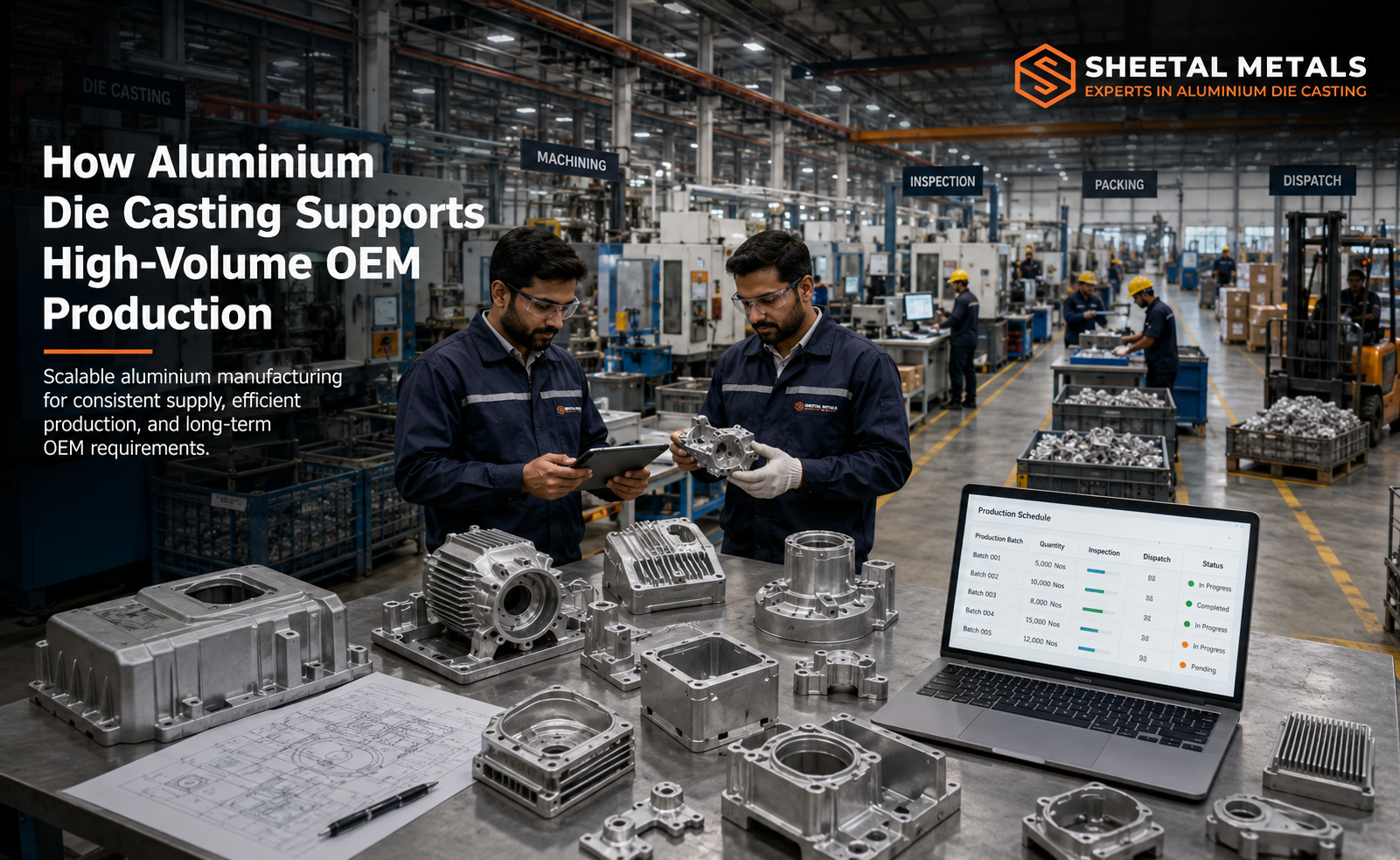
When an automotive or industrial company launches a product, component demand can rise quickly. The supplier must then deliver large quantities without disrupting the customer’s assembly line.
This requires more than a capable casting machine.
It requires production planning, tooling control, capacity management, process stability, and dependable supply.
Aluminium die casting is well suited to this environment. The process uses reusable dies and controlled production cycles. This allows manufacturers to produce large quantities of similar components with an established production system.
For OEMs, this creates a practical path from initial production to regular high-volume supply.
Sheetal Metals provides aluminium pressure die casting and CNC machining services for customers requiring aluminium components for automotive, EV, electronics, lighting, and industrial applications.
Why High-Volume OEM Production Is Different
A small production order and a long-term OEM program have different requirements.
An OEM program may continue for months or years. Demand can also change based on vehicle production, market demand, and customer forecasts.
The supplier must therefore manage the following:
- Production capacity
- Tool availability
- Raw material planning
- Production schedules
- Quality requirements
- Delivery commitments
- Recurring orders
The goal is simple.
The right quantity must reach the customer at the right time.
A strong production system makes this easier to achieve.
Reusable Tooling Makes Repeated Production Practical
Tooling is a major part of die casting.
A precision die creates the required component shape during each casting cycle. Once the tooling is validated, it can support repeated production.
This is important for OEM programs.
The manufacturer does not need to create a new mould for every batch. Instead, the approved tooling can support ongoing production according to its maintenance and service requirements.
This makes repeated manufacturing more practical.
Tool condition also matters.
Regular monitoring and planned maintenance can help maintain stable production over the life of the tooling.
Production Capacity Must Match OEM Demand
High-volume manufacturing requires careful capacity planning.
An OEM may provide a monthly or annual production forecast. The supplier then needs to assess whether available equipment, tooling, manpower, and supporting processes can handle the expected demand.
Capacity planning can consider:
- Required quantity
- Number of production shifts
- Machine availability
- Cycle requirements
- Tooling capacity
- Secondary operations
- Inspection requirements
Good planning helps prevent unexpected production bottlenecks.
It also gives customers greater confidence when their demand increases.
Scaling Production Requires Process Discipline
Production volume can increase quickly after product approval.
However, increasing quantity should not mean changing the basic manufacturing approach without proper planning.
A stable production process provides a foundation for scaling.
Manufacturers can use established operating parameters, inspection methods, and production procedures for recurring orders.
This creates greater predictability.
For OEM customers, predictable production is valuable because their own assembly schedules depend on a steady component supply.
Recurring Orders Need Better Production Planning
OEM supply is rarely limited to one shipment.
Many programs involve recurring orders based on customer forecasts.
This changes how suppliers manage production.
Instead of looking at each order separately, manufacturers can plan upcoming requirements together.
They can review:
- Previous consumption
- Current orders
- Forecasted demand
- Production capacity
- Raw material requirements
- Delivery schedules
This approach supports better production coordination.
It can also reduce last-minute manufacturing pressure.
Supply Continuity Is Critical for OEMs
A component shortage can affect an entire assembly operation.
This makes supply continuity an important part of supplier performance.
For this reason, OEM manufacturers need a production partner that can coordinate manufacturing and delivery effectively.
An integrated setup can simplify this process.
Instead of coordinating separate suppliers for every production stage, customers can work with one manufacturing partner for multiple requirements.
This can make communication faster and reduce unnecessary coordination.
Combining Casting With Secondary Manufacturing
Not every aluminium component is ready for assembly immediately after casting.
Some parts require additional operations.
These may include CNC machining, VMC machining, shot blasting, primer coating, or powder coating.
When these capabilities are available within the same manufacturing setup, the production flow becomes easier to coordinate.
The casting stage can be followed by the required value-added operations before final inspection and dispatch.
For OEMs, this can simplify sourcing.
It can also reduce the need to manage multiple vendors for different stages.
Supporting Changes During Long-Term OEM Programs
OEM products can change during development and production.
A component may require a dimensional update, machining change, coating adjustment, or tooling modification.
These changes need clear communication.
A responsive manufacturing partner can coordinate with the customer and relevant production teams.
This helps reduce confusion when engineering changes are introduced.
It also supports smoother transitions between different production requirements.
Why Production Consistency Matters at Scale
At low volumes, a small production issue may affect a limited number of components.
At high volumes, the same issue can affect thousands of parts.
That is why production consistency becomes increasingly important as order quantities grow.
Manufacturers need defined processes for:
- Production monitoring
- Tool management
- Inspection
- Machining
- Finishing
- Packing
- Dispatch
Consistent processes help identify problems early.
They also support predictable production across recurring orders.
How Sheetal Metals Supports High-Volume OEM Production
Sheetal Metals provides aluminium pressure die casting and CNC machining services for customers seeking reliable aluminium component manufacturing.
Its value-added capabilities include:
- Aluminium High Pressure Die Casting
- CNC machining
- VMC machining
- Shot blasting
- Primer coating
- Powder coating
- Inspection
- Packaging and dispatch
This integrated capability allows customers to coordinate multiple manufacturing requirements through one supplier.
Sheetal Metals supports projects ranging from new-part development and import substitution to alternate-source development and serial production.
This makes the manufacturing setup suitable for OEMs and growing businesses that require a scalable aluminium component supply chain.
Suitable Industries for High-Volume Aluminium Components
High-volume aluminium die casting can support production programs across several industries.
These include:
- Automotive
- Electric vehicles
- Electric motors
- Gearboxes
- Battery systems
- Electronics
- Electrical equipment
- Lighting
- Industrial machinery
Each sector has different component requirements.
However, they share one important need: reliable production at the required volume.
Conclusion
High-volume OEM production requires a manufacturing system that can grow with customer demand.
Aluminium die casting provides a strong foundation for repeated component production. Reusable tooling, controlled production cycles, and scalable manufacturing make it suitable for ongoing OEM programs.
However, successful high-volume supply involves more than casting.
Production planning, tool management, secondary operations, inspection, and delivery coordination all play important roles.
An integrated manufacturing partner can simplify these requirements.
Sheetal Metals supports OEM customers with aluminium pressure die casting, CNC and VMC machining, shot blasting, primer coating, powder coating, inspection, packaging, and dispatch services.
By bringing multiple manufacturing stages together, Sheetal Metals helps customers manage aluminium component production through a coordinated supply chain.
For OEMs planning recurring or high-volume production, the right manufacturing setup can provide greater supply stability, easier coordination, and a stronger foundation for long-term growth.
📅 Last updated: