
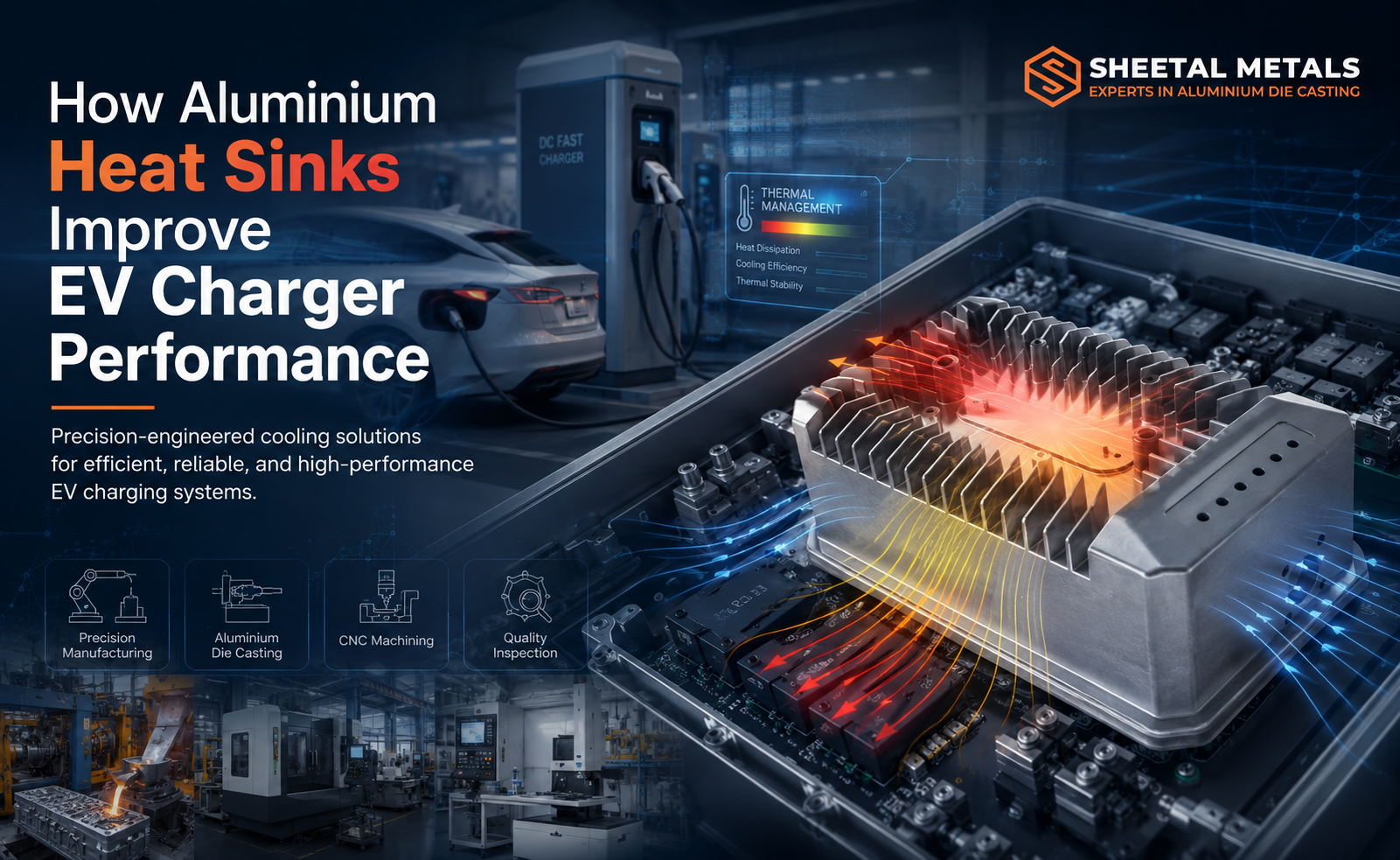
Electric vehicles are becoming a common sight on roads across the world.
As EV adoption grows, the demand for fast, safe, and reliable charging infrastructure also continues to increase.
Modern EV chargers handle high electrical loads for long periods. During charging, electronic components generate a significant amount of heat. If this heat is not controlled, it can reduce efficiency, slow charging speeds, and shorten the charger’s lifespan.
This is where aluminium heat sinks become essential.
They help remove excess heat from power electronics and maintain a stable operating temperature. Better thermal management leads to improved charger performance, longer component life, and greater reliability.
Manufacturers therefore rely on precision aluminium heat sinks that deliver consistent cooling under demanding conditions.
At Sheetal Metals, we manufacture precision aluminium heat sinks using aluminium pressure die casting and CNC machining services. We support OEMs and EV charger manufacturers with high-quality aluminium components designed to meet modern engineering requirements.
Why Heat Management Matters in EV Chargers
Every EV charger contains power electronics that convert and regulate electrical energy.
These include components such as:
- Power modules
- IGBTs
- MOSFETs
- Rectifiers
- Power control boards
While operating, these components naturally generate heat.
If the temperature rises beyond the recommended limit, several problems may occur.
These include:
- Lower charging efficiency
- Reduced charging speed
- Electronic component failure
- Unexpected shutdowns
- Higher maintenance costs
- Shorter product life
Efficient thermal management helps prevent these issues.
That is why heat sinks have become a critical part of modern EV charger design.
Why Aluminium Is the Preferred Material
Different metals can transfer heat.
However, aluminium offers the best balance between performance, weight, and cost.
It provides excellent thermal conductivity while remaining lightweight and corrosion resistant.
These properties make it ideal for EV charging applications.
Aluminium also allows manufacturers to create complex cooling fin designs through pressure die casting.
This improves heat dissipation without increasing product size.
Another important advantage is recyclability.
Aluminium can be recycled repeatedly without losing its essential properties, making it a sustainable choice for modern manufacturing.
How Aluminium Heat Sinks Remove Heat
The job of a heat sink is simple.
It absorbs heat from electronic components and transfers it into the surrounding air.
The process happens in three stages.
First, heat moves from the electronic device into the aluminium heat sink.
Next, heat spreads across the entire heat sink.
Finally, the cooling fins release that heat into the surrounding air.
This continuous cycle keeps electronic components within a safe operating temperature.
As a result, the EV charger performs more efficiently and operates more reliably.
The Importance of Heat Sink Design
A heat sink is much more than a block of aluminium.
Its design directly affects cooling performance.
Engineers carefully optimize several features.
These include:
- Fin height
- Fin spacing
- Fin thickness
- Base thickness
- Airflow direction
- Mounting surfaces
Even small design improvements can significantly increase heat dissipation.
A well-designed heat sink also helps reduce the charger’s overall size while maintaining excellent cooling performance.
Aluminium Pressure Die Casting Creates Complex Heat Sinks
Modern EV chargers require compact and lightweight cooling solutions.
Aluminium pressure die casting makes this possible.
Molten aluminium is injected into a precision steel die under high pressure.
This process creates detailed cooling fins, complex shapes, and accurate dimensions in a single operation.
Pressure die casting offers several advantages.
It provides:
- Excellent dimensional consistency
- High production efficiency
- Smooth surface finish
- Repeatable quality
- Reduced material waste
These benefits make pressure die casting one of the most effective manufacturing methods for aluminium heat sinks.
CNC Machining Adds Precision
After die casting, some heat sink features require additional machining.
CNC machining improves critical dimensions that affect assembly and performance.
Typical machining operations include the following:
- Precision drilling
- Thread tapping
- Surface milling
- Flatness correction
- Mounting hole machining
These operations ensure that the heat sink fits perfectly with electronic components.
At Sheetal Metals, we combine aluminium pressure die casting with CNC machining services to manufacture precision aluminium heat sinks that meet demanding customer specifications.
How Sheetal Metals Supports EV Charger Manufacturers
EV charger manufacturers require more than quality components.
They need a manufacturing partner that understands precision, consistency, and production efficiency.
Sheetal Metals supports customers by providing:
- Custom aluminium heat sink manufacturing
- Aluminium pressure die casting services
- Precision CNC machining
- OEM component manufacturing
- Prototype and production support
- Consistent quality inspection
- Reliable production for industrial applications
Our manufacturing capabilities help customers develop aluminium components that support efficient thermal management and long-term product reliability.
Benefits of Aluminium Heat Sinks in Fast EV Chargers
Fast EV chargers operate at much higher power levels than standard chargers.
As charging speed increases, heat generation also rises.
Without effective cooling, internal temperatures can increase rapidly.
This affects both safety and performance.
Aluminium heat sinks help maintain stable operating temperatures during continuous charging.
Their thermal conductivity allows heat to spread quickly across the cooling surface.
This improves heat dissipation and reduces thermal stress on sensitive electronic components.
Well-designed aluminium heat sinks also provide several important benefits.
These include:
- Better charging efficiency
- Stable operating temperatures
- Longer electronic component life
- Improved system reliability
- Lower maintenance requirements
- Consistent charging performance
For high-power EV chargers, efficient cooling is not an option. It is a necessity.
Applications of Aluminium Heat Sinks in EV Charging Systems
Aluminium heat sinks are used in many parts of an EV charger.
Each application requires reliable thermal management.
Common applications include:
- DC fast chargers
- AC charging stations
- Power converter modules
- Charging control units
- Power supply systems
- Battery energy storage interfaces
- High-power semiconductor modules
Every application depends on efficient heat transfer to ensure stable and safe operation.
As EV charging technology continues to evolve, the demand for advanced aluminium heat sinks will continue to grow.
Quality Manufacturing Makes the Difference
A heat sink performs well only when it is manufactured with precision.
Small dimensional errors can reduce cooling efficiency.
Poor surface quality can also affect heat transfer between the electronic component and the heat sink.
For this reason, every manufacturing stage must follow strict quality standards.
At Sheetal Metals, quality is built into the manufacturing process.
Our production team carefully monitors each stage to ensure consistent results.
Every aluminium heat sink undergoes inspections that may include
- Dimensional verification
- Visual inspection
- Surface quality checks
- Machined feature inspection
- Overall product consistency
This systematic approach helps deliver reliable aluminium components that meet customer specifications.
Supporting OEMs with Precision Manufacturing Services
Every EV charger manufacturer has different design requirements.
Some projects require compact heat sinks.
Others need larger cooling solutions for high-power charging systems.
Sheetal Metals supports these requirements through flexible manufacturing services.
Our capabilities include:
- Custom aluminium heat sink manufacturing
- Aluminium pressure die casting
- Precision CNC machining
- Prototype development
- Batch production
- High-volume manufacturing
- Precision aluminium components for industrial applications
We work with customers to manufacture aluminium components that match their engineering drawings and production requirements.
This approach helps OEMs simplify production while maintaining consistent quality.
Aluminium Supports Sustainable Manufacturing
Sustainability is becoming an important part of modern manufacturing.
Aluminium supports this goal in several ways.
It is one of the most recyclable engineering materials available.
It can be recycled many times without losing its essential properties.
This reduces material waste and helps conserve natural resources.
Pressure die casting also supports efficient material utilization.
Combined with durable product performance, aluminium heat sinks contribute to more responsible manufacturing practices.
For companies building next-generation EV charging infrastructure, sustainability is becoming just as important as performance.
Choosing the Right Manufacturing Partner
Selecting the right manufacturing partner is essential for producing high-quality EV charger components.
A reliable supplier should offer more than production capacity.
Look for a manufacturer with:
- Experience in aluminium pressure die casting
- Precision CNC machining capabilities
- Strong quality control processes
- Engineering support
- Consistent production standards
- Reliable delivery schedules
Working with an experienced manufacturer helps reduce production risks and supports long-term product performance.
Conclusion
EV charging technology is advancing rapidly.
As chargers become faster and more powerful, effective thermal management becomes even more important.
Aluminium heat sinks play a critical role in maintaining safe operating temperatures, protecting electronic components, and improving charger reliability.
Their lightweight construction, excellent thermal conductivity, corrosion resistance, and manufacturing flexibility make them the preferred choice for modern EV charging systems.
At Sheetal Metals, we manufacture precision aluminium heat sinks using aluminium pressure die casting and CNC machining services. We support OEMs and industrial manufacturers with custom aluminium components designed for reliable thermal performance, consistent quality, and long-term durability.
As the EV industry continues to grow, precision-engineered aluminium heat sinks will remain an essential part of efficient and dependable charging infrastructure. Choosing the right manufacturing partner ensures that every component meets the highest standards of quality, performance, and reliability.
📅 Last updated:
