Finding the right manufacturing partner is an important business decision.
A reliable aluminium die casting manufacturer does more than produce parts. The right partner helps improve product quality, maintain delivery schedules, reduce production risks, and support long-term business growth.
Today, industries such as electric vehicles, automotive, electronics, lighting, industrial automation, and engineering require precision aluminium components. These industries also expect consistent quality and dependable production.
However, not every manufacturer offers the same capabilities.
Before selecting a supplier, it is important to evaluate several key factors.
This guide explains what businesses should consider before choosing an aluminium die casting manufacturer.
Why Your Manufacturing Partner Matters
A supplier becomes part of your production process.
Poor-quality components can delay projects. They can increase costs. They can also affect the performance of your final product.
On the other hand, an experienced manufacturer can improve production efficiency and product reliability.
A dependable manufacturing partner helps you:
- Maintain consistent product quality
- Reduce production delays
- Improve supply chain reliability
- Minimise rejection rates
- Support future product development
Choosing the right manufacturer is an investment in long-term success.
Check the Manufacturer’s Experience
Experience matters.
An established manufacturer understands different product designs, production challenges, and customer requirements.
They also have better knowledge of tooling, casting processes, machining, and quality control.
Instead of looking only at the number of years in business, evaluate the industries they serve.
A manufacturer that supplies components for automotive, EV, electronics, and industrial applications usually has experience handling complex engineering requirements.
Evaluate Manufacturing Capabilities
Every manufacturer has different production capabilities.
Before making a decision, understand the complete manufacturing process.
Ask whether the company provides:
- Aluminium pressure die casting
- CNC machining
- Tool development
- Surface finishing
- Quality inspection
- Assembly support
Working with a manufacturer that offers multiple services under one roof can simplify production management.
It can also reduce lead time and improve communication.
Review Quality Control Standards
Quality should never be compromised.
Even a small dimensional error can create assembly problems.
Ask how the manufacturer checks product quality.
A reliable company should inspect the following:
- Critical dimensions
- Surface finish
- Casting quality
- Machined features
- Functional requirements
Consistent quality inspection helps reduce rejected parts and improves customer confidence.
It also supports long-term product performance.
Look for Precision Manufacturing
Modern industries require tight tolerances.
Components must fit perfectly during assembly.
Precision manufacturing helps achieve this.
High-quality dies produce consistent castings.
CNC machining improves important dimensions such as holes, threads, mounting surfaces, and sealing areas.
Ask the manufacturer about their machining capabilities and dimensional control process.
Better precision usually means fewer production problems later.
Understand Production Capacity
Production requirements often change.
A manufacturer should be able to support both current and future demand.
Ask questions such as:
- Can they handle large production volumes?
- Can production increase when demand grows?
- How do they manage delivery schedules?
- What is their average production lead time?
A supplier with scalable production can support business growth without affecting quality.
Ask About Material Expertise
Not every aluminium alloy is suitable for every application.
Different products require different material properties.
Some applications need higher strength.
Others require better heat dissipation or corrosion resistance.
An experienced manufacturer can recommend the right aluminium alloy based on the product’s operating conditions.
This technical support helps improve final product performance.
Evaluate Communication and Technical Support
Good communication is often overlooked.
However, it is one of the most important factors.
Projects move faster when technical discussions are clear.
Choose a manufacturer that responds quickly and provides accurate information.
A reliable supplier should help with:
- Design discussions
- Manufacturing recommendations
- Production updates
- Technical clarification
- Problem-solving
Strong communication reduces misunderstandings and improves project execution.
Consider Industry Experience
Different industries have different manufacturing requirements.
For example:
- EV components require lightweight and precise parts.
- Electronics need accurate enclosures and heat management.
- Industrial equipment demands durable components.
- Automotive products require consistent production quality.
A manufacturer with experience across multiple industries is often better prepared to meet complex requirements.
Their broader knowledge can also help improve product design and manufacturing efficiency.
Sustainability Is Becoming More Important
Many companies now include sustainability in supplier evaluation.
Aluminium supports responsible manufacturing because it is highly recyclable.
Efficient production processes can also reduce material waste.
Ask how the manufacturer approaches material efficiency, waste reduction, and production consistency.
Responsible manufacturing benefits both businesses and the environment.
Why Long-Term Partnerships Matter
Selecting a supplier is not only about the first order.
It is about building a long-term relationship.
A trusted manufacturing partner understands your products, quality expectations, and production goals.
Over time, this can improve communication, reduce development time, and support continuous improvement.
Long-term partnerships often create better business outcomes than changing suppliers frequently.
How Sheetal Metals Supports Modern Manufacturing
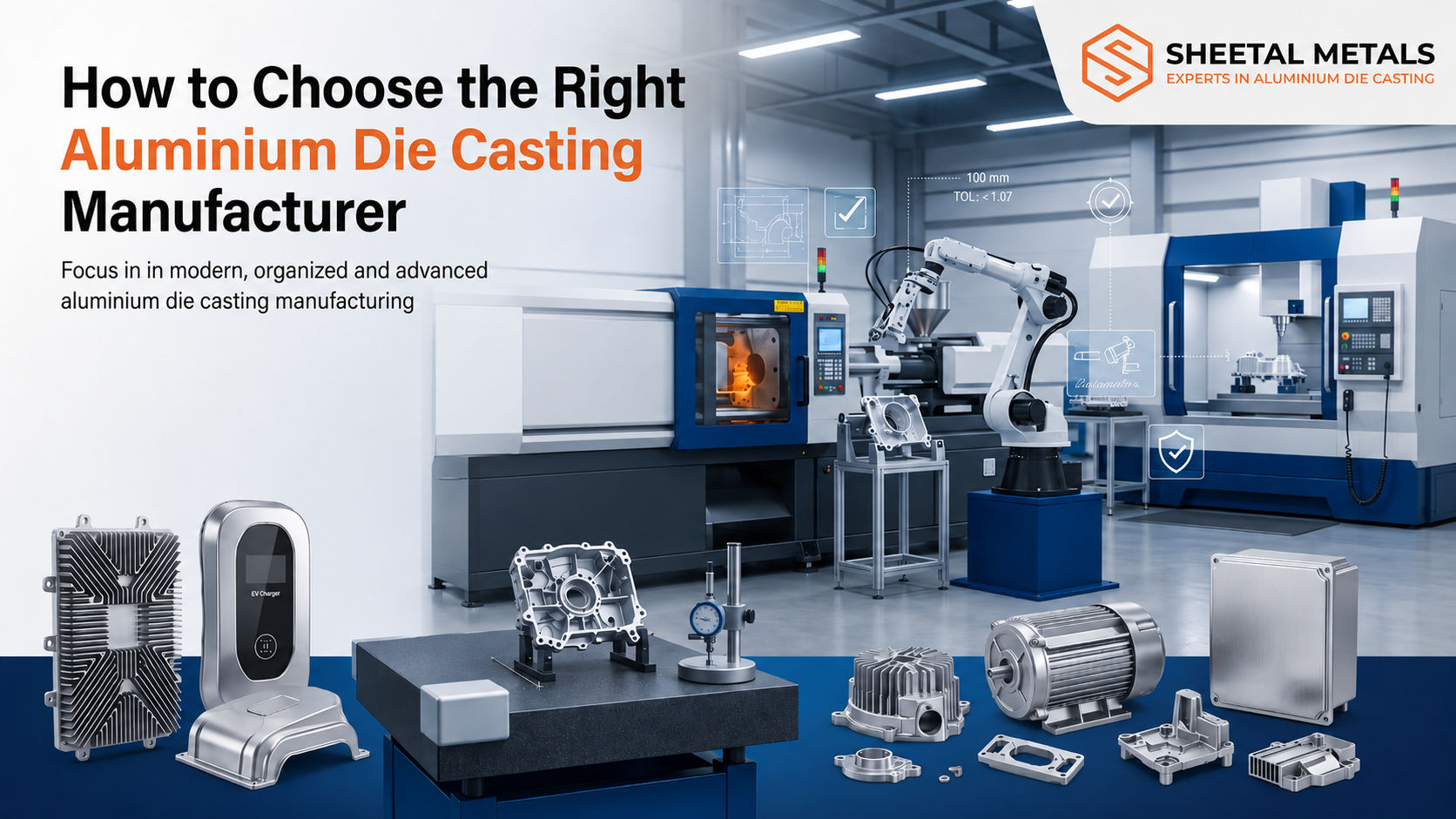
Sheetal Metals manufactures precision aluminium die-cast components for industries including automotive, electric vehicles, electronics, lighting, and industrial equipment.
The company combines aluminium pressure die casting with CNC machining to produce accurate and reliable components.
By focusing on precision, consistent quality, and dependable manufacturing processes, Sheetal Metals supports customers looking for aluminium components that meet demanding engineering requirements.
Its integrated manufacturing capabilities help simplify production while maintaining high product standards.
Final Checklist Before Choosing a Manufacturer
Before making your decision, confirm that your supplier offers:
✔ Experience in your industry
✔ Aluminium pressure die casting expertise
✔ CNC machining capabilities
✔ Strong quality control
✔ Consistent production capacity
✔ Technical support
✔ Reliable communication
✔ On-time delivery
✔ Precision manufacturing
✔ Long-term partnership potential
Evaluating these factors helps reduce risk and improve project success.
Conclusion
Choosing the right aluminium die casting manufacturer is about much more than price.
The right supplier becomes a valuable business partner.
They help improve product quality, reduce production challenges, and support future growth.
By evaluating experience, manufacturing capabilities, quality control, technical expertise, and communication, businesses can make informed decisions.
Companies that invest time in selecting the right manufacturing partner often achieve better product performance, greater production efficiency, and stronger customer satisfaction.
For businesses seeking precision aluminium components, working with an experienced manufacturer such as Sheetal Metals provides the confidence needed to support today’s demanding industrial applications and tomorrow’s growth.
📅 Last updated: